Sign this Petition to Boycott Harvard’s DoubleTree Suites

Workers at Harvard’s DoubleTree Suites care for Harvard students, professors, families and guests every day. They are members of the Harvard community, and deserve to be treated with respect and dignity.

DoubleTree workers have sought a fair process to decide upon unionization since March 2013. Delmy Lemus, a room attendant, explained: “I am asking Harvard for the same thing they have given their other employees: the right to a fair process to decide on unionization.  I want to be treated like a human being, not just a pair of hands and a back.” Harvard has not yet agreed to a fair process.

DoubleTree workers have taken the brave step of calling for a boycott of their own hotel.

As Harvard students, faculty, staff and community members, we urge you to support workers at Harvard’s DoubleTree Suites

Sign this Petition & Tell Sodexo: Stop Using the Affordable Care Act As An Excuse To Cut Benefits

The Affordable Care Act, also known as “Obamacare” was created to increase the availability of benefits to workers nationwide. Do not to use the Affordable Care Act as an excuse to cut benefits for your workers.

Why is this important?

My name is Liz Helton. For eight years, I have worked for Sodexo at Earlham College in Richmond, Indiana, proudly serving food to students on campus. My husband is a cancer survivor with an inoperable tumor in his chest. Having health care means everything to us.
 
When college is in session, I am scheduled to work 37 hours per week. Since the Affordable Care Act (ACA) requires employers to provide benefits to employees who work at least 30 hours a week, I should be covered. But, I’m not.

My employer, Sodexo, a multi-billion dollar international food service company, which services hundreds of college campuses across the country, has announced it will eliminate existing health care coverage and benefits for thousands of employees. That means workers like me who thought we were about to get insurance are now being denied. And, they are blaming the Affordable Care Act, also known as “Obamacare.” The law requires employers like Sodexo to provide health insurance to employees who work 30 hours per week.

Using a loophole in the Affordable Care Act (ACA), Sodexo is cutting benefits to workers at college campuses around the country. Those workers haven’t had their hours cut. Instead, Sodexo has used a loophole in the Affordable Care Act (ACA) to designate those workers as “part-time”. School year workers have to average more than 30 hours a week on a 52-week calendar in order to qualify for benefits like healthcare and sick days - even though we don’t work year-round.
 
Since Sodexo took advantage of this loophole, I found out I was not eligible for Sodexo's insurance, Indiana Medicaid or subsidies through the exchanges. Today, my husband and I have no coverage. I am just one of thousands of Sodexo workers nationwide who have been reclassified as "part-time." Nothing changed for us. We still work the same amount of hours. Now, we don't have benefits.
  
This huge corporation, which has 125,000 employees in the United States - and had revenues last year of over $25 billion, is hiding behind the Affordable Care Act to hurt workers like me. To be clear, the law doesn't require Sodexo to make me “part-time,” but nothing in the law prevents Sodexo from doing so. One expert told the Boston Globe, “There’s nothing in the law that requires Sodexo do this....They are choosing to do this.” This sets a dangerous precedent for workers. And, as a result, workers like me have lost health insurance and other benefits at work. 

The clear intent of the Affordable Care Act is to increase health care coverage for millions nationwide. We all fought hard for that.  Now we need your help to close the Sodexo loophole and stop the company from cutting benefits. 

Sign my petition and help send Sodexo a message that you are with us in our fight.

Sheryl Sandberg Leans Out of Hotel Worker Meeting

Earlier this week, a group of housekeepers, nightclub servers and other employees from a Hilton DoubleTree hotel in Cambridge, which is on a property owned by Harvard, gathered outside the gates of the university while Sheryl Sandberg delivered a speech to this year’s graduates. It was a last ditch attempt by these workers to score a meeting with the Facebook COO, who had already declined their invitation to meet with them and host a “Lean In circle,” saying she didn’t have the time.

What a missed opportunity.

Okay, yes, the invitation to Sandberg was by-and-large a publicity stunt (and a great one, at that) by the union to draw attention to their campaign to organize these workers, 70% of whom have signed a petition asking for “fair process,” according to a story in the Boston Globe.

But behind it was a chance to illustrate, first-hand, the ways in which Sandberg’s “Lean In” philosophy can apply to all women, including the ones who clean-up the boardrooms and serve coffee at the high-end women’s networking conferences she attends. These workers are looking for a higher wage, affordable health insurance and standardized workloads. A recent survey of the DoubleTree workers by a Harvard student found that every employee suffered from chronic pain as a result of the job and all said their workloads had increased in recent years.

One of the abiding criticisms of Sandbergian feminism is that is elitist, and relies on a sort of trickle-down feminism to help most women: basically, get more female CEOs and the rest will fall in place. Of course, the world doesn’t exactly work like that and with 70% of Americans either living in or on the brink of poverty women, that is something we can’t ignore.

The Lean In foundations rejects these accusations, saying that its model can serve lower-income women as well. According to the Globe, they’ve partnered with Dress for Success, and support Lean In circles of domestic workers in San Francisco and rescued sex slaves in Miami. “The principles of Lean In are just as, if not more, important to women with lower incomes,” Lean In foundation spokeswoman Andrea Saul told the Globe in an e-mail.

Still, meeting with this group would have taken this commitment an important step further. Sandberg and Lean In would not just have been expanding their halo to include working class women, but also the institutions that can help them. In this case that institution is the labor movement. The fact is, it has never been and will never be easy for a nightclub waitress or a housekeeper working for a large corporation to lean in on her own. Let’s put it this way: if someone with an MBA from Harvard needs a book like Sandberg’s to give her the confidence to demand parity in the workplace, you can only imagine what an immigrant women with far less education needs to fighting the same top bosses for what she believes is just.

In her Class Day speech Sandberg told the audience that expectations for solving gender equality are too low today. I agree. I think a large part of the problem is the feeling that we have to go at it alone, and make changes in our lives and homes instead of fighting for systemic ones. But here was a group of women whose expectations were as high as their willingness to fight. Too bad Sandberg didn’t take 20 minutes to help them lean in even harder.

Sheryl Sandberg! Lean In with Harvard’s DoubleTree workers!

The women who work at Harvar’ds DoubleTree are leaning in! They want to meet with Sheryl Sandberg when she is in town for Harvard’s class day on May 28th. Sheryl, lean in with the DoubleTree workers!  Click on the title above to view the video.


Workers trying to unionize appeal to Sheryl Sandberg

With Facebook executive Sheryl Sandberg coming to town next week, a group of housekeepers, nightclub servers, and other employees of a Boston hotel are trying to turn her now-famous campaign for empowering women in their favor as they move toward forming a union.

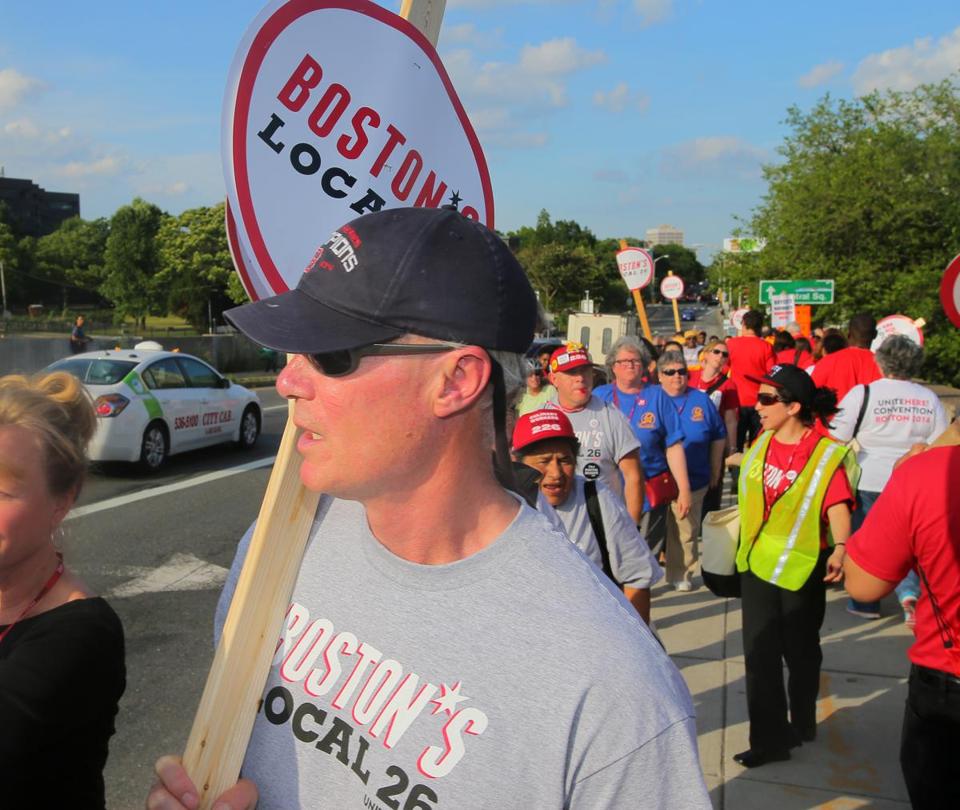
Unite Here Local 26, which is organizing workers at the Hilton DoubleTree Suites hotel near the Charles River, said it wanted to enlist Sandberg’s help after facing resistance from Hilton and receiving no encouragement from Harvard University, which owns the property where the hotel is located.

So, the union decided, why not appeal to the author of the bestseller “Lean In: Women, Work, and the Will to Lead”?

Organizers asked Sandberg to meet with the hotel’s female workers. They started an online petition calling for her to become involved in their cause. And they created leaflets depicting the book’s cover, with faces of housekeepers replacing Sandberg’s, and a message that reads, “Sheryl Sandberg, will you lean in with the women of Harvard’s hotel?”

The Facebook chief operating officer, who is scheduled to deliver a Class Day address at Harvard Wednesday, has sent word she does not have time to host a “Lean In circle” with the hotel employees. Undeterred, the workers are planning to hand out the leaflets during Sandberg’s speech in Harvard Yard.

“It’s a way of continuing to say to Harvard that at every turn these women are going to be in your face,” said Brian Lang, president of Local 26, which represents hospitality industry workers. “It’s very clear to us that Harvard is calling the shots.”

Lang said the school already has about 600 unionized food service workers on campus.

Going after the property owner, along with the business owner, is a tactic unions sometimes use to garner more attention for their campaigns, said James Green, a labor historian at the University of Massachusetts Boston. And invoking a high-visibility landlord like Harvard is a natural fit. “It’s got the reputation of being a liberal institution,” he said.

Bill Murphy, Harvard’s director of labor and employee relations, said through a spokesman that it “will support any fair process for unionization that is agreed upon between Hilton and Local 26.”

But in a letter sent to the union last May, Murphy wrote that Harvard “respectfully declines Local 26’s request for the university to insert itself into this organizing campaign.”

The attempt to unionize the workers began more than a year ago, when 70 percent of the approximately 112 nonmanagerial workers at the DoubleTree — housekeepers, banquet servers, front desk agents, van drivers, and Scullers Jazz Club employees — signed a petition asking for a “fair process,” Local 26 said.

Such an agreement would allow them to discuss joining a union without retaliation from the company. When a group of workers and Harvard students tried to deliver the petition to the former general manager, he refused to accept it, according to Local 26.

Emma Perdomo (right) is depicted on a fliter modeled after Sheryl Sandberg’s best-selling book (left).


Emma Perdomo (right) is depicted on a fliter modeled after Sheryl Sandberg’s best-selling book (left).

In March, the union called for a boycott of the hotel and workers started asking regular guests to stay elsewhere.

A spokesman for Hilton Worldwide, which operates the DoubleTree Suites, said the appropriate way to determine if workers want to organize is through a secret ballot overseen by the National Labor Relations Board.

Hilton also said most of the hotel’s workers do not want union representation.

“This belief was reinforced by the recent protest rally at the hotel that was attended by only a very small minority of our team members and by a nearly complete absence of employee support for subsequent unsuccessful rallies that the union has tried to organize,” the company said in a statement. “We have reason to believe that a large majority actively oppose any boycott.”

DoubleTree management has held meetings with employees, both in groups and one-on-one, to discourage them from unionizing, according to Local 26. It said management retaliated against one organizing committee member by putting fliers in the cafeteria and locker room calling him a “mole” and taking away extra shifts at Scullers.

Hilton declined to respond to the allegations.

Sandberg has been criticized for creating a movement aimed at financially well-off women, but her Lean In foundation says it has partnered with several organizations that serve lower-income women, including Dress for Success, and supports Lean In circles of domestic workers in San Francisco, as well as rescued sex slaves in Miami.

“The principles of Lean In are just as, if not more, important to women with lower incomes,” foundation spokeswoman Andrea Saul said in an e-mail.

As part of the local hospitality workers union, DoubleTree workers would stand to get a bump in pay, more affordable health insurance, and standardized workloads.

DoubleTree workers are not necessarily on the bottom rung of the economic ladder. Housekeeper Delmy Lemus, for instance, earns $15.82 an hour, plus tips, and has access to company-subsidized health insurance.

But Lemus, 33, said the family plan rates would consume nearly half her weekly paycheck. She decided to opt out of the benefit and enroll herself and her two daughters in MassHealth, the state insurance plan for low-income residents.

The job is physically demanding, Lemus said. When she was pregnant with her now 4-year-old daughter, Lemus began suffering sciatic nerve pain and was barely able to stand by the end of her shifts.

In her eighth month of pregnancy, she was assigned to the hotel’s laundry room. Lemus said she had to push carts loaded with linen and pull out heavy sofa beds.

“Almost every day I was crying,” the Revere resident said.

In a survey of dozens of DoubleTree workers done for Local 26 last summer, Harvard student Gabriel Bayard said every employee he interviewed complained of chronic pain, and nearly all said their workloads had increased in recent years.

More than 100 Harvard students have gotten involved in the DoubleTree campaign, including Sasanka Jinadasa, 21, president of the Radcliffe Union of Students, a feminist advocacy group. “If [Harvard] has a vested interest in the profits and the outcome of the company, it should care about what the workers want as well,” she said.

“Harvard has a duty to make sure that the standards of the DoubleTree are up to the standards of the workers on campus.”

Lemus, a single mother, wants to save up enough money to send her daughters to college and eventually start her own housecleaning service. She said “leaning in” to make her voice heard, and fighting for union protections, is the beginning of that process.

“We’re just housekeepers, people without education. But we work very hard,” she said. “We have dreams. . . . We don’t want to die cleaning rooms in a hotel.”

Katie Johnston can be reached at [email protected]. Follow her on Twitter @ktkjohnston.